Cross-Country EV Road Trip: Dayton to San Diego and Back
By Thomas Wischgoll
We had not taken a road trip for a while and wanted to visit with family. So we decided to take our EV to find out how well the charging infrastructure supports long-distance road trips.
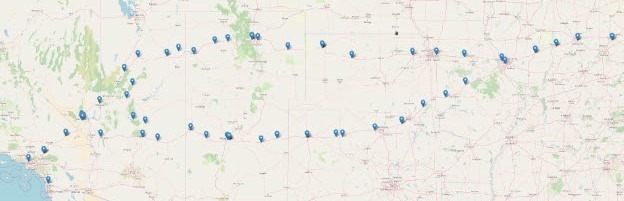
Our road trip started near Dayton, OH with a destination in San Diego, CA. On our way, we wanted to visit with family and friends in St. Louis, MO, Albuquerque, NM, and Las Vegas, NV.
In addition, we made two work-related stops at the Los Angeles Convention Center and the National Renewable Energy Laboratory (NREL) in Golden, CO.
Trip Overview With All Our Stops
What We’re Driving: Audi E-tron
The EV for this road trip is a 2019 Audi E-tron with 21-inch wheels and the latest software updates applied to increase the usable capacity of the battery. This allows the car to use 86 kWh of the 95 kWh battery with an official range of 212 miles.
With its 400V architecture, it is capable of charging at about 150 kW between 0-80%. After that, the charging curve gradually drops slowly. At 99%, the vehicle can still charge at 46 kW.
This flat charging curve is quite advantageous on road trips as one does not have to pay too much attention to when to charge. For example, the battery does not need to be nearly depleted in order for the vehicle to achieve peak charging.
Planning
The entire trip was planned using A Better Route Planner to determine the required charging stops with a charging target of 80% for most stops.
Only for those sections that were cutting it a bit too close, we charged deeper into the battery pack. For example, we charged to 100% in Flagstaff, AZ to make sure we were able to complete the entire loop around the south rim of the Grand Canyon.
There is no ability for A Better Route Planner to obtain live data from the E-tron in the U.S. as that feature is only available through Tronity which is only available in Europe.
We reserved all the hotels for the first half of the trip in advance and picked hotels with level 2 charging wherever possible. Charging at hotels of course meant that the planned charging stops as determined by A Better Route Planner did not always apply anymore. I typically reran the planned route from the current location with the current state of charge of the battery every morning to ensure we knew what our charging stops needed to be.
Dayton to St. Louis
We started our trip near Dayton, Ohio, with a fully charged battery taking advantage of the built-in timer to have the battery finish charging right when we were about to leave.
In order to get to our first stop overnight in St. Louis, we needed three charging stops according to A Better Route Planner: Indianapolis, Terre Haute, and the Firefly Grill. We hit some bad traffic due to construction where the freeway was closed and traffic diverted near Effingham, IL. This meant stop-and-go traffic for about two hours.
Fortunately, stop-and-go traffic does not use much energy in an EV. So we made it to the Firefly grill without needing an additional charging stop. But since it was later than planned we had dinner while charging the car.
The car was already done charging shortly after placing our order so we moved the car in order to not block the charger.
Once we arrived in St. Louis, we spent two days there and were able to rely on the level 2 charger available at our hotel to get around town and to all the sightseeing spots.
After St. Louis Along Route 66
As there was not much we wanted to see in the remainder of Missouri and Oklahoma, we drove mostly straight through past Oklahoma City where we spent the night.
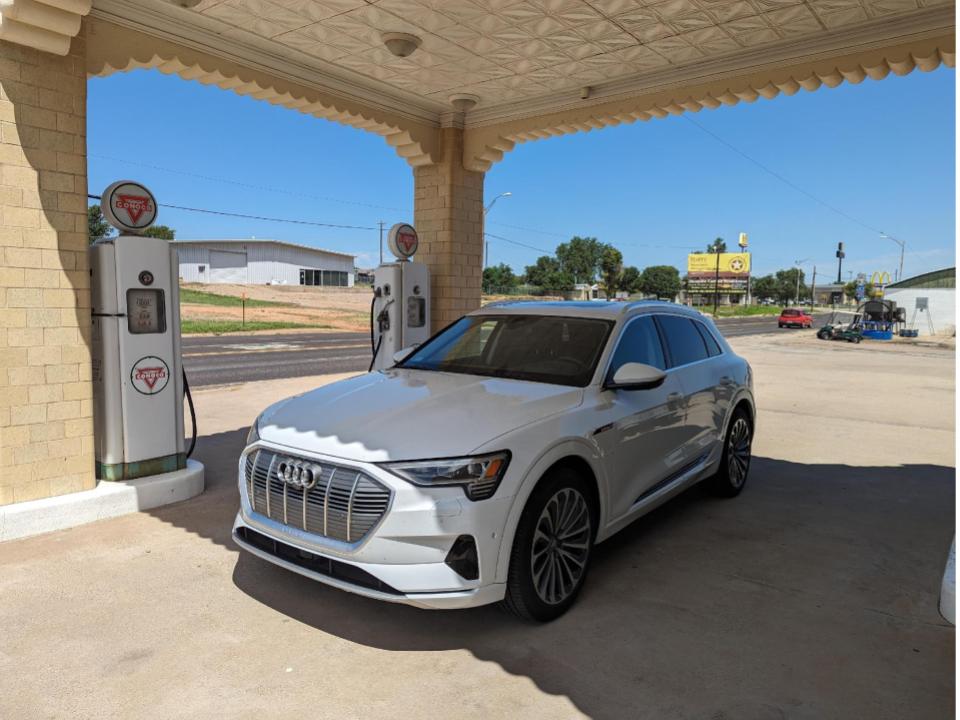
Charging worked without any issues. Once in Texas, we stopped at a historic gas station (figure 2) along Route 66. Our trip continued through Amarillo so we stopped at the Cadillac Ranch.
next stop: Albuquerque
The hotel there had a couple of level 2 charging spots. Since we arrived with a low state of charge, we used one of the Electrify America stations after arriving at the hotel.
It was fairly hot with temperatures around 109 degrees. The station had 10 outlets but half of them were slow likely due to cable cooling failing. But the station was not overly busy and people were very friendly helping each other out by pointing arriving cars to the remaining chargers that were capable of delivering reasonable charging speeds.
For the next couple of days, we relied on the level 2 charger at the hotel parking next to a PHEV from the Cincinnati area charging every night as well.
Route 66
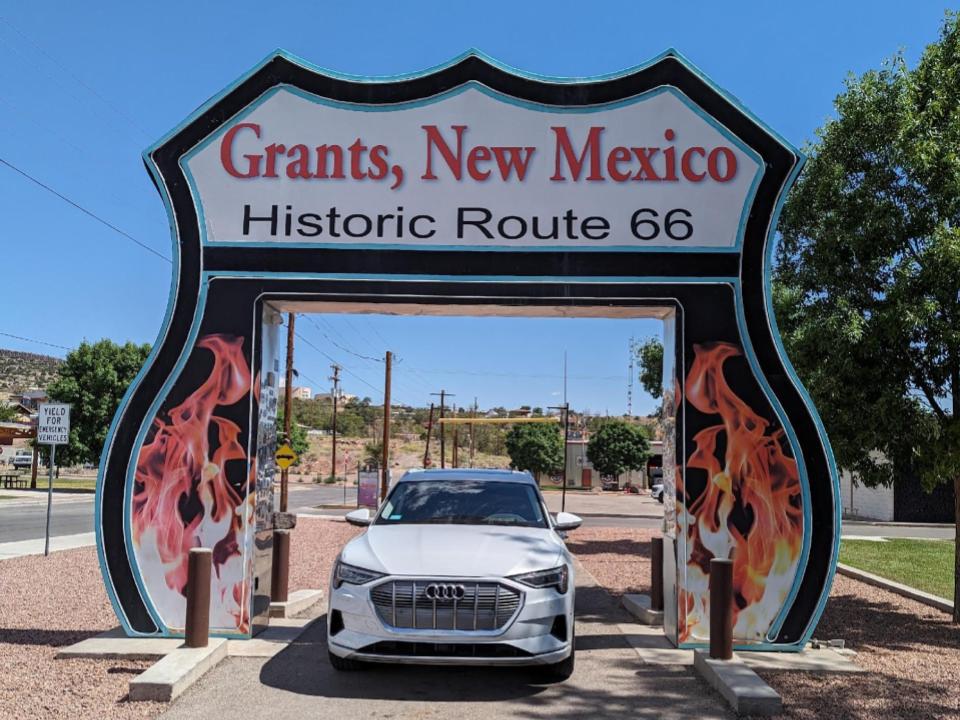
Since we were driving parallel to Route 66, we stopped in Grants, New Mexico, at one of those Route 66 drive-through signs.
We then stopped in Gallup, NM, to charge. The Electrify America station was fairly full with just one charger left.
Once charged up again, we headed to the Petrified Forest National Park. The park ended up being more widespread than we expected but we still had plenty of energy left in the battery to make it to our next charging stop in Winslow, AZ. There we stopped at the “Standing on the Corner” park before charging.
We then continued to Flagstaff, AZ, where our hotel had free level 2 charging. We charged to 100% overnight to ensure we can make it all around the south rim of the Grand Canyon. We went up US Route 89 to get to the Desert View Watchtower first and then along the south rim to the Grand Canyon Visitor Center.
We stopped at various viewpoints to enjoy the overlook of the Grand Canyon.
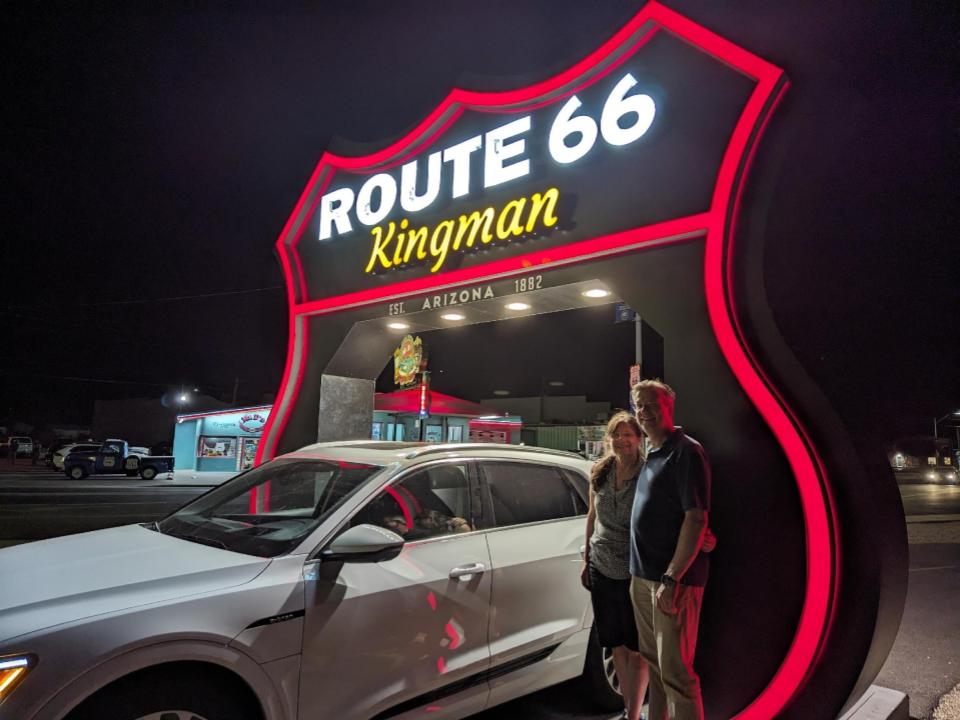
Our next overnight stop was in Kingman, AZ, where they had another Route 66 drive-through sign.
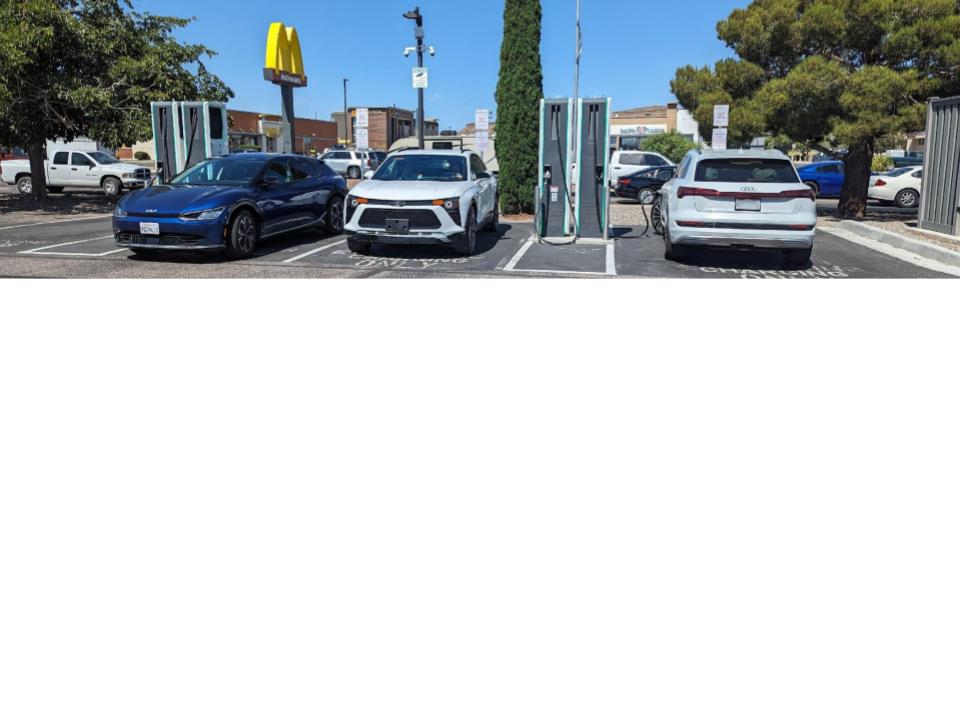
The hotel in Kingman did not have a charger so we stopped at the Electrify America station to charge the car the next morning.
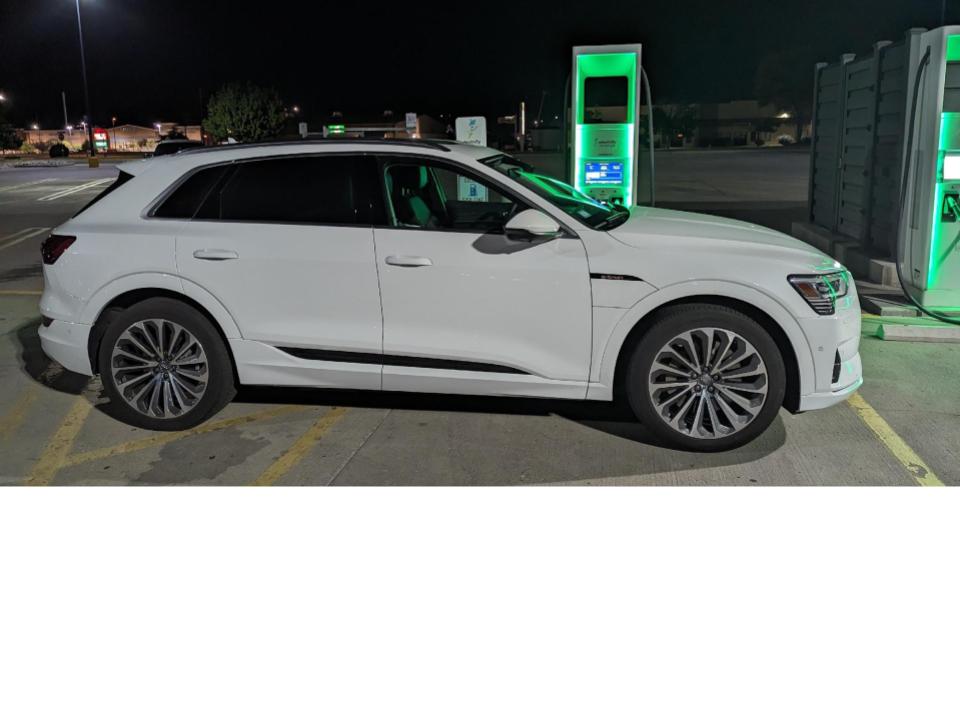
After charging for a few minutes, a Chevrolet Equinox prototype pulled in. It had all the emblems and some other areas taped off to disguise the vehicle. The headlights appeared to be preliminary. It seemed they were trying to test the charging performance.
Las Vegas to San Diego
From Kingman, we continued our trip to Las Vegas.
As pointed out earlier, we tried to book hotels that provided EV charging. Our hotel in Las Vegas had a fairly large parking structure available that served two large hotels. Despite that, there were only four chargers provided among the hundreds of parking spots. This meant that we were not able to charge at all as all four stations were already in use.
As a result, we tried to use a fast charger the next morning. However, we had to learn that the charging infrastructure was really struggling in Las Vegas. This may have been due to the high temperatures as it was very hot at 119 degrees.
The first Electrify America station we tried had four stations and a line with cars waiting. People were complaining about the slow charging speed. When it was our turn, we got to experience how slow it really was as the charger was providing a measly 4 kW. Since that is slower than many level 2 chargers, we found a mall with level 2 charging at 7 kW which was at least faster than what the Electrify America station provided. There also was an Electrify America station at that mall. So we walked over there to see how well these stations worked.
Unfortunately, cars were charging at no more than 25 kW. Due to the slow charging speed, there were several cars lined up. So while charging the the level 2 station, we looked for other chargers in the area. We did not want to drive too far as our battery was already below 10% and level 2 charging would not increase the state of charge quickly enough.
We found a ChargePoint station nearby that was available according to the ChargePoint app. This station was limited to 22 kW. When we arrived at that station, it was indeed available. After plugging in, it provided the promised 22 kW. However, the charging speed dropped fairly quickly and ended up at only 1.3 kW. So we kept searching on the various apps for other stations.
We ultimately found another Electrify America station that was about 8 miles away and showed several stations as available. When we arrived, most stations were indeed available and once we plugged in, the station charged the car at 90 kW, which was a much better charge rate after all the previous experiences in Las Vegas. This station provided enough of a charge to get us to the next station in Baker, CA.
With another charging stop in Hesperia, CA, we managed to reach our destination near San Diego, CA, where we spent a couple of weeks visiting family.
San Diego to Arches National Park
Our first stop on our way back to Ohio was in Los Angeles. Our hotel had charging but it was only level 1. So we did not gain a lot of energy overnight.
Fortunately, the Los Angeles Convention Center, where we attended a conference, had chargers available. We were lucky to get access to the last remaining charger so that we got enough juice to get back to Hesperia, CA.
When we arrived at the next charging location in Baker, CA, there was only one out of the twelve spots left. After plugging in, a line was forming. Even the Tesla chargers only had two spots left despite there being over 40 Tesla chargers.
Since we did not want to charge in Las Vegas again due to the slow charging speed the time last time we tried, we charged to 100%. The E-tron charges fairly fast even when going past 80%. The entire charging session took only 27 minutes despite going for a full charge. Fortunately, the station cleared out a little while we were charging so we were not blocking anybody.
We then made it past Las Vegas to Mesquite, NV. Our next hotel was in Karnab, UT, with few fast chargers on the way. So we charged to 100% again to ensure we could get to our hotel.
When we mapped out the route using A Better Route Planner, it routed us around Zion National Park. However, the Audi navigation directed us straight through Zion. Unfortunately, it was already getting late and past sunset. So the park was rather dark forcing us to slow down even more.
Once at our hotel, all the level 2 chargers were in use at the hotel. Hence, we used a ChargePoint charger capable of delivering 100 kW shared across two stations. Since we were the only EV charging, we got decent charging speed and explored the town while charging.
Taking the Scenic Route
From Karnab, we drove past Bryce Canyon National Park straight toward Arches National Park
We made wit three charging stops in Beaver, Salina, and Green River, UT. We arrived just in time for our reserved time slot at Arches National Park.
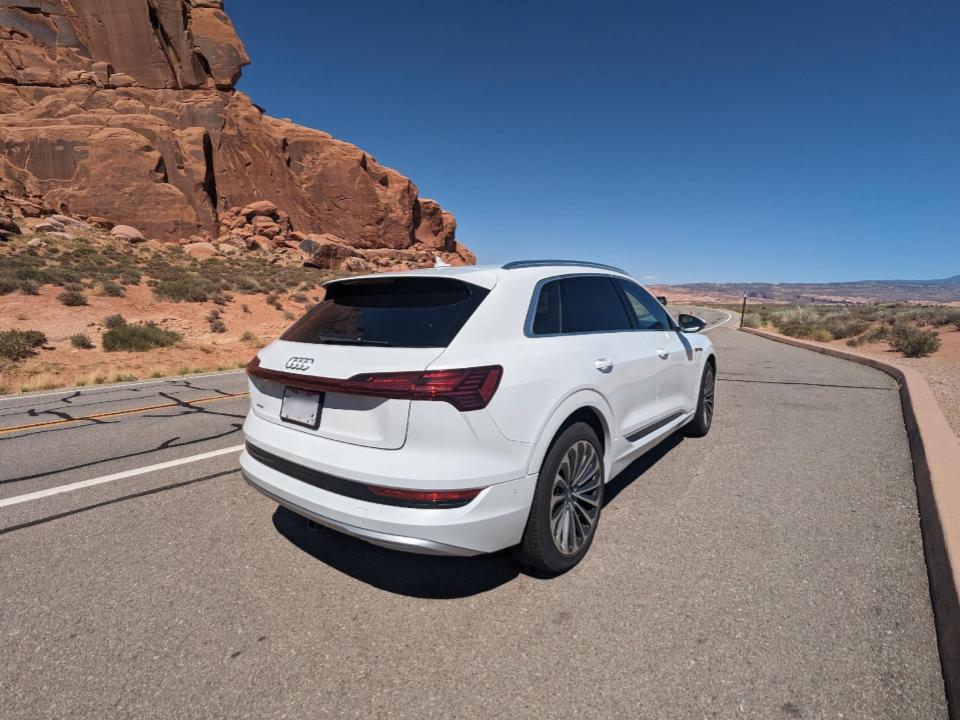
Exploring the entire area of the Arches National Park, we stopped at almost every viewpoint. It was very hot that day with temperatures at 109 degrees. Due to the high temperature, we extensively took advantage of the auxiliary air conditioning to keep the car’s cabin cool at pretty much every stop.
Even with the additional energy expended on the extra air conditioning, the battery was still at 50% state of charge when we left the Arches National Park.
Arches To Denver
A Better Route Planner had suggested a ChargePoint fast charger in Moab for us to use. However, I was not able to find it in the ChargePoint app. Since going to that charger meant a 20-mile round trip, we decided to not risk not finding an available charger. Instead, we went back to Green River which meant 34 extra miles but guaranteed not getting stranded.
Once we had enough electricity back in the battery, we continued on to Grand Junction. Our hotel did not have any level 2 chargers so we drove to an Electrify America station after checking in at the hotel.
Since it was past 10 pm when we arrived, Sam’s Club was already closed. There was nobody else charging so we just parked in a more convenient way for us to account for the short cables of the older-style charging cabinets . This does point out the shortcomings of a lot of Electrify America locations as there are no services, such as bathrooms available when arriving later at night.
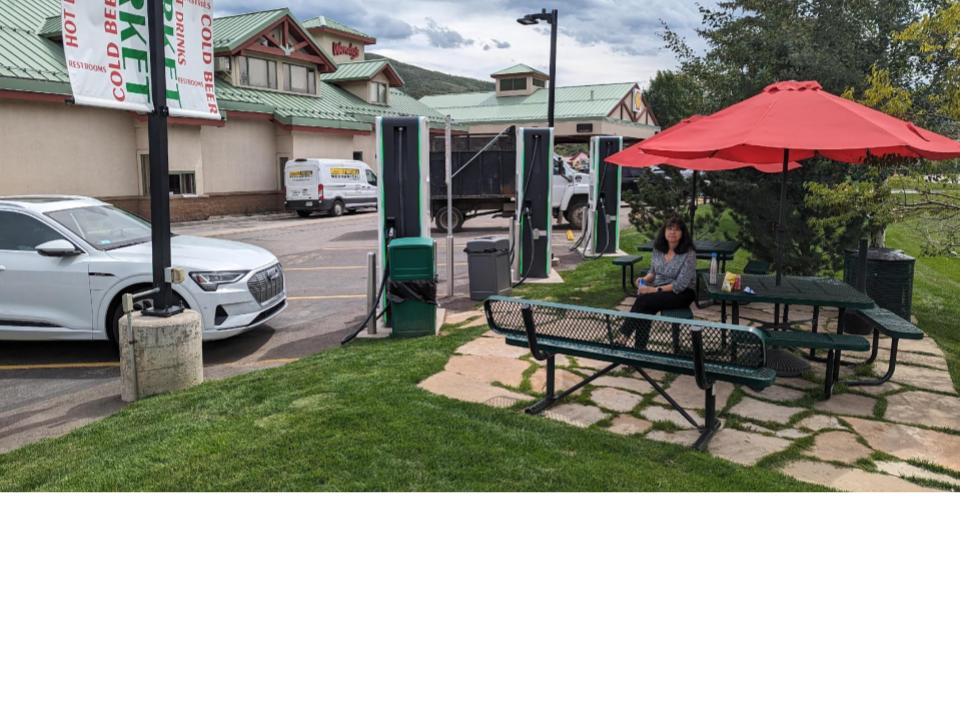
The next day, we continued our trip toward Denver, CO. The second charging stop had a nice picnic area to sit at while waiting for the car to charge. We had some snacks and drinks in a cooler in the car that we enjoyed until the car was ready to go.
Denver to Dayton
The night before we left, we charged at a mall near the hotel. When checking the next few charging stations on our route, we noticed that people reported low charging speeds at the I-70 Diner location. So we decided to charge again to 100% at the last station in the Denver area to minimize the amount of energy we needed at the I-70 Diner.
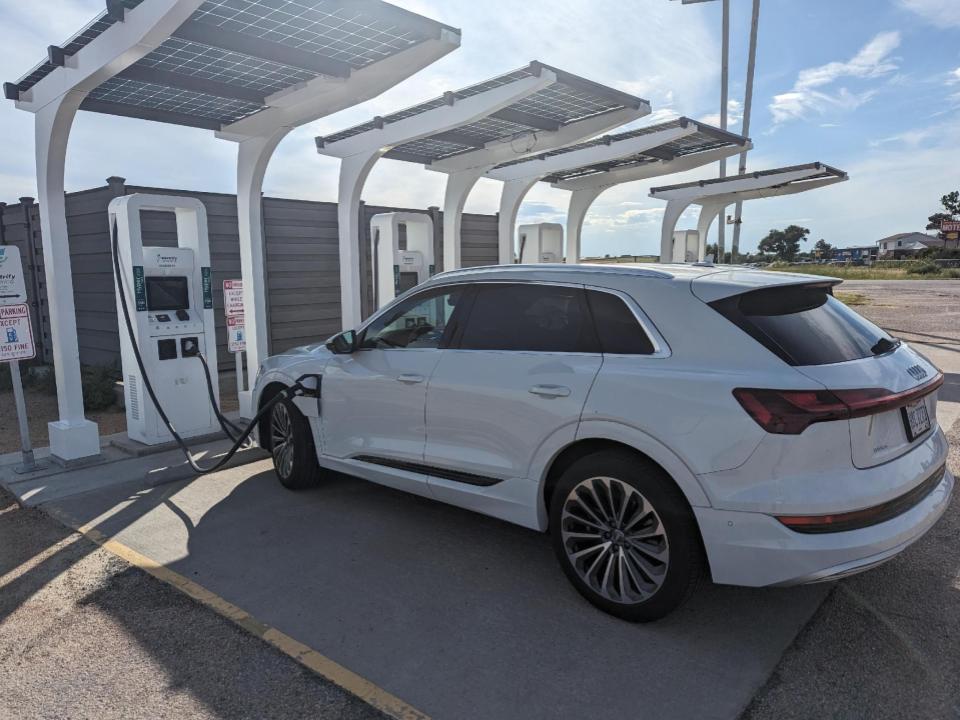
When we arrived there, we were the only car charging. The chargers had little canopies to provide a little protection from the elements. The diner was not open and from what we found out on the internet, it may not open for quite a while. Overall, the area was quite deserted with only a gas station and a liquor store being open.
Charging speed averaged 42 kW which was not great but faster than some people reported on PlugShare. Since we only needed 23 kWh to get to the next charger, we were able to leave after 33 minutes.
Kansas, Ilinois and back to Ohio
We successfully made it to the next Electrify America charging location to get us to our hotel in Hays, KS. The hotel had level 2 chargers (one J1772 and two Tesla destination chargers) to get the car fully charged for the next morning.
There was a storm approaching as we were driving through Kansas and we tried to time it so we could avoid that storm. While we managed to avoid the rain, we experienced strong headwinds which increased the energy usage significantly resulting in a 30% increase in the energy required.
Fortunately, we had enough of a buffer to make it to the next charging stop. We then compensated for the increased demand for energy by charging a little deeper into the battery pack than what A Better Route Planner suggested.
We tried to push it a little further on this leg of the trip to get past the construction near Effingham that we got stuck in on the way out. So it got rather late for our next overnight spot. Since we did not know in advance how far we would be able to get, we did not reserve a hotel room in advance.
But we managed to find a hotel near the highway in Terre Haute near the Electrify America location where we charged the next morning.
From there, we stopped again in Indianapolis to charge and have lunch. From there, we were able to drive straight home.
Conclusion
Charging and range anxiety a non-issue on successful trip
Overall, the trip worked out very well with only a few issues with charging.
- We had to switch chargers a few times to get better charging speeds. But at the vast majority of charging locations, we just plugged in the car and it started charging at the expected speed.
- There were very few charging locations with additional amenities. Even simple things like trash cans were rare. Very few stations provided tools to clean the windshield. Regular stores, such as Walmart, Target, and Sam’s Club, which tend to host a lot of Electrify America stations often close at 10 pm. This means that there is no bathrooms available after that time. Notable exceptions were the station in Edwards, CO with trash and recycle bins and a nice picnic area, and the location in Baker, CA with a full-size canopy.
- It did not feel like we had to compromise at all with an EV on the trip. Even going through the different national parks did not seem to put us at a disadvantage. On the contrary, driving the EV allowed us to just leave the AC on during all the sightseeing stops to better be able to deal with the heat.
- Going over the mountains did not seem to affect the overall efficiency of the car. The additional energy it took to go up the mountain was regained through regenerative breaking on the way down. The excellent thermal management of the E-tron allowed the car to always utilize the full regeneration level whenever needed even after going downhill for a while.
- The Guess-O-Meter seemed reasonably accurate and always erred on the side of caution. So we always knew how far we could still go. There really was no range anxiety on this trip. The average efficiency was 2.44 miles per kWh. The entire trip was over 5000 miles.
- While we were not able to account for all the free level 2 charging at hotels, we used just over 2000 kWh at all the metered chargers. The average wait time for charging the car at fast chargers was just below 20 minutes. Most of the time we used that time to go to the bathroom or get something to eat. So we would have stopped at those locations anyway.
Altogether, this was a very successful trip with charging proving to be a non-issue even when going great distances as we did on this tip.